We Have Launched Scope Request: A Feature Request Board on Your Own Server
This is our second product launch in a week. TerraSuite went out on Saturday, and today we are publishing Scope Request: a feature request board you install on your own server, where your customers suggest things, vote on each other’s suggestions, and find out what happened to them.
The two are not as unrelated as they look, because the second one exists because of the first.
We built it because we needed it
When TerraSuite went into its limited beta with a small number of carefully chosen agencies, we needed somewhere for them to tell us what the software should do next. That is not an unusual thing to want, and there are several good hosted tools that do it.
We could not find one that did all of what we wanted at a price that made sense for a product with a free tier. The ones we looked at meter something that grows as the board succeeds: the number of people associated with feedback, the number of colleagues who moderate, or the number of products you run a board for. A board that is working brings in more voters and more posts, and on every one of those models that is the same thing as a larger bill.
We also wanted the board’s data to sit where everything else already sits. A feedback board holds your customers’ addresses and their written complaints about your software, and on a licence all of that lives in your own database, under your own backups, in the jurisdiction you already chose. Nobody else holds a member record, so there is no processor to agree terms with and nothing extra to audit once a year.
So we wrote one. It has been running our own feedback for a while, which is the only reason we are confident enough to sell it.
What it actually is
Three screens and a moderation queue behind them.
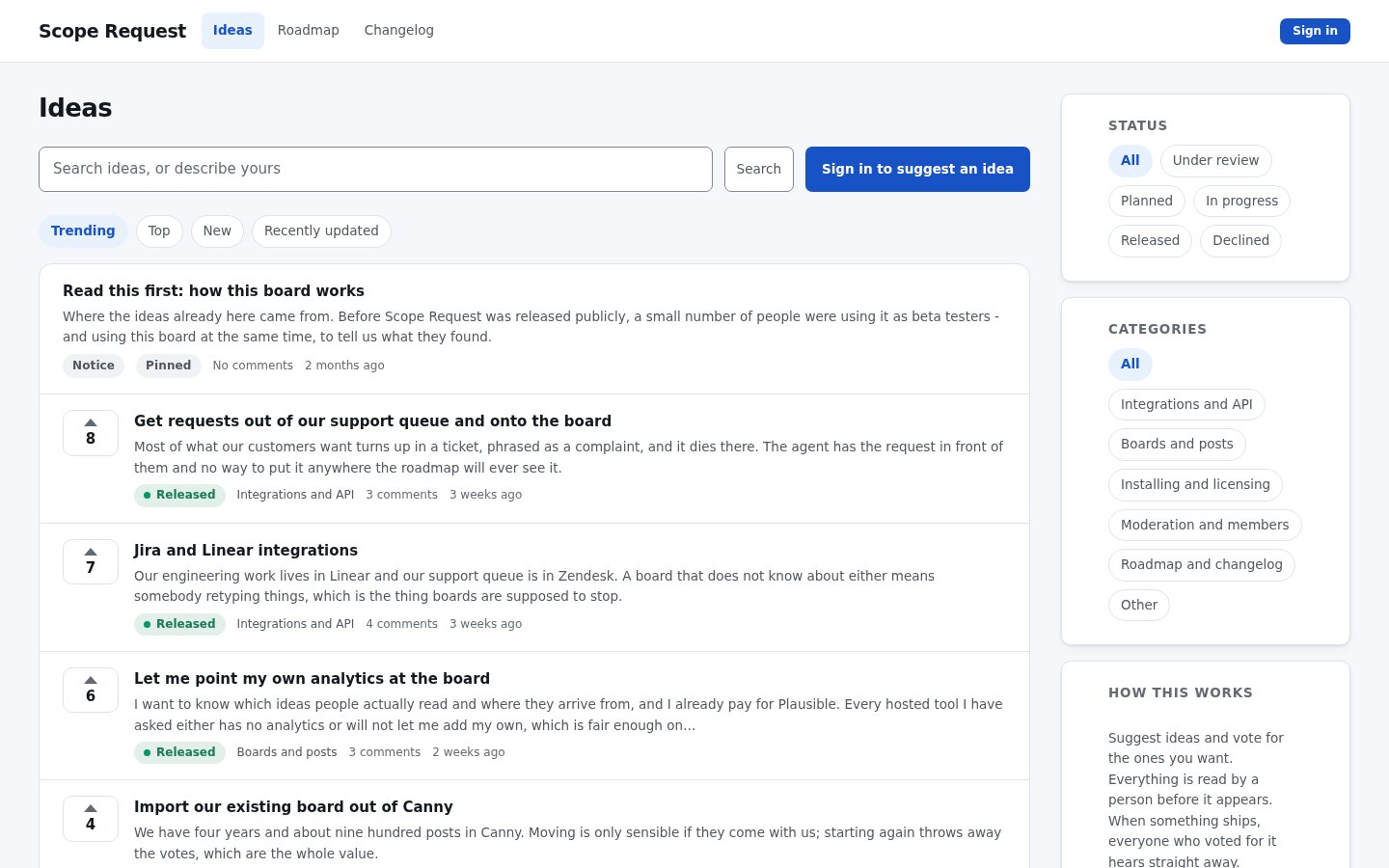
Our own board. Every idea on it was posted by one of our beta testers.
Ideas is the list: anybody can read it, members post and vote, and each post carries a status, a category and a vote count. Roadmap is the same posts arranged as planned, in progress and recently released. Changelog is what actually shipped, with an RSS and an Atom feed and an email list that gets one message when something ships and nothing else.
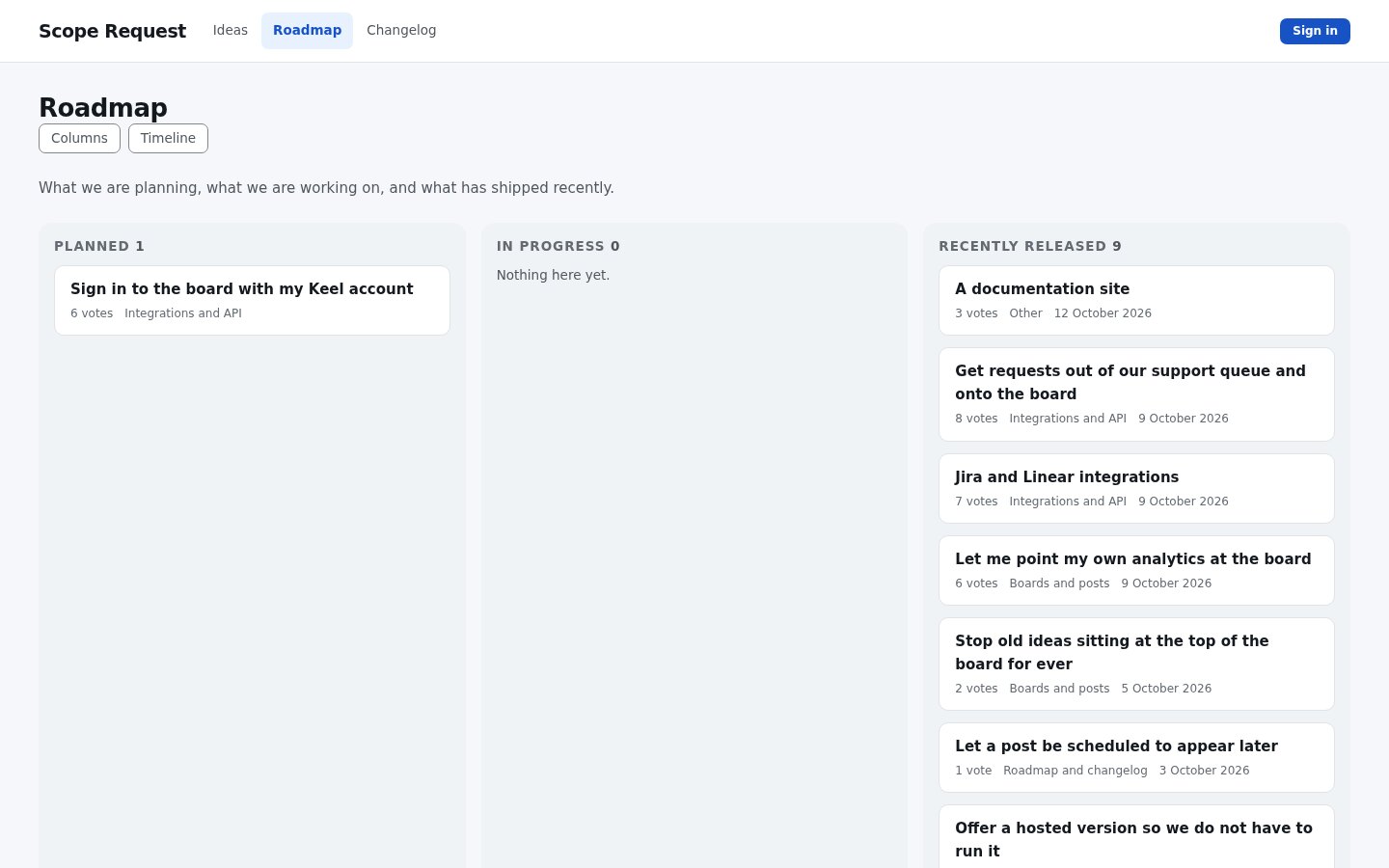
The roadmap is built from the posts themselves, so it cannot drift away from them.
The part that matters more than any of those is that everyone who voted for a thing is told when it ships. That is the whole point of running a board rather than an inbox, and it is the step that is easiest to drop.
Everything written by a member is read by a member of staff and approved before it appears on the board. There is a moderation queue with trust thresholds, so a member who has posted sensibly before stops going through it, and an audit log of every decision. There is also triage that suggests whether a post looks like spam, with a short reason rather than a score, and flags likely duplicates. It only ever suggests.
It reads your issue tracker, and your support desk writes to it
Two connections, in opposite directions, and the directions are deliberate.
Link a post to the issue behind it in GitHub, Jira, Linear or GitLab and closing that issue as done moves the idea to Released and tells everyone who voted. Nothing is ever written back. Your tracker belongs to the people doing the work, and a feedback board has no business editing it.
Your support desk goes the other way. Most of what a customer wants arrives in a ticket, phrased as a complaint, and dies there, because the agent has the request in front of them and nowhere to put it. Zendesk, Intercom and Help Scout point their own webhook straight at the board and are verified with their own signature; Freshdesk, Zapier, n8n and Make use a signed address of your own. A ticket becomes an idea held for a moderator, or a vote on an idea you name, and the customer is never named in public. They wrote to support. They did not choose to appear on a board.
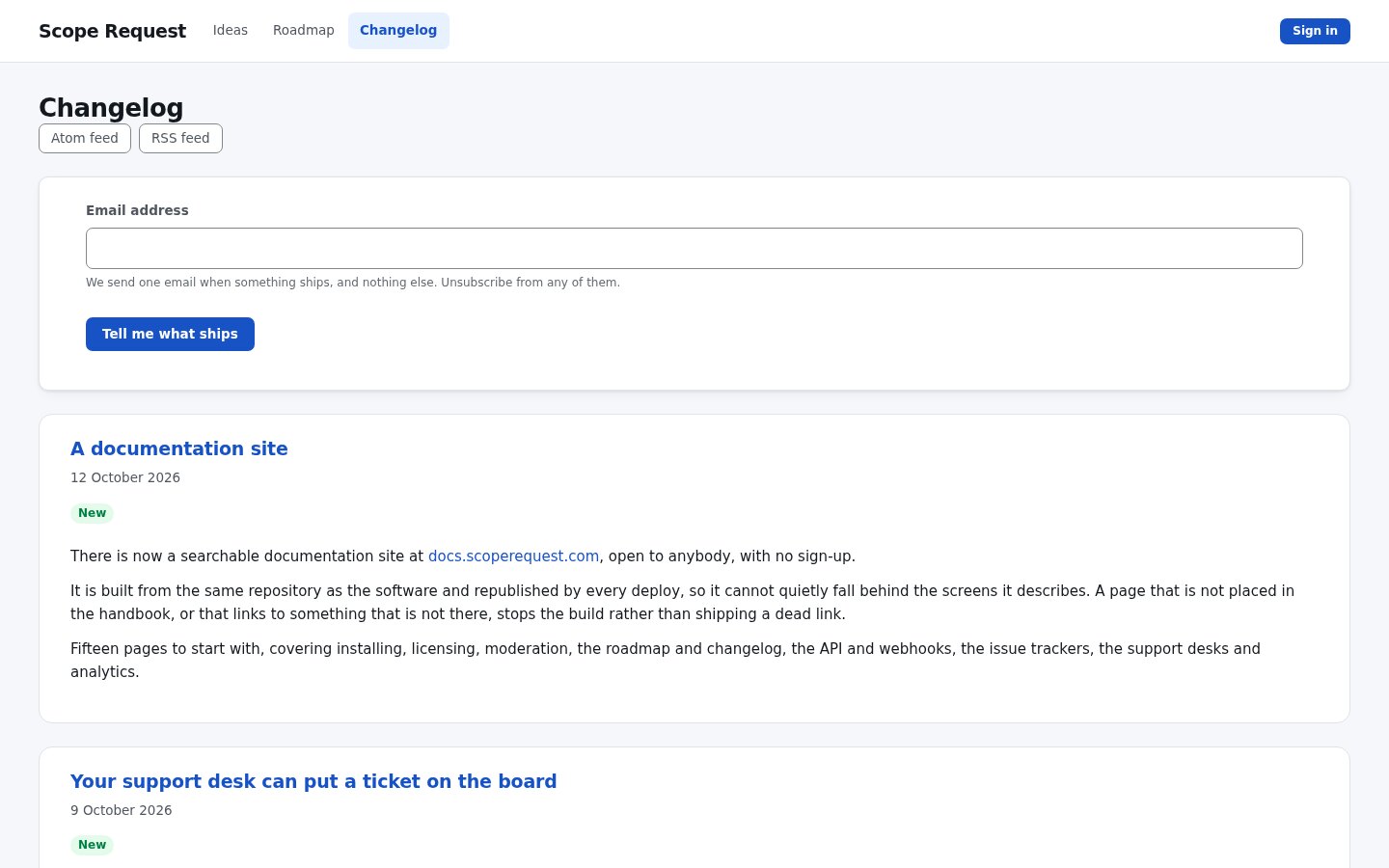
The changelog, with a feed and an email list. Each note names the requests it answers.
The bill does not grow with the board
One licence, per install, per year. A board with ten thousand voters costs what a board with ten costs, so the cost per customer asked falls every month the board does its job.
The free licence does have limits, and they are set out below. But a limit is not a meter: nothing at any price is charged by the voter, the seat, the moderator or the product, so the figure you agree in the first year is the figure in the fifth.
There is no analytics on it unless you put some there. Tracking is a setting, off until you turn it on, and the footer tells your visitors which of the two is true. If you already pay for an analytics service you can point the board at it, and the content security policy names the hosts you chose rather than guessing.
Have a look at ours
We did not build a demonstration site, because we have two real boards running in public and they are more honest than a demonstration would be.
- feedback.scoperequest.com is Scope Request’s own board, running Scope Request.
- feedback.terrasuite.uk is TerraSuite’s, which is the one that started all this.
The documentation is at docs.scoperequest.com and is open to anybody, no sign-up.
What it costs
The free licence runs one product with one board and up to fifty ideas, with the whole moderation system, the roadmap, the changelog and the email notifications. It is not a trial and it does not expire.
£199 a year lifts the limits entirely and adds custom fields, private boards, the REST API, webhooks and chat alerts, the WordPress connector, CSV import and export, reports and prioritisation, your own domain and your own branding. £499 a year adds unlimited products on one install, single sign-on from your own application, the customer record beside a voter, the embeddable widget and full white labelling.
If you would rather not run it, we will: £45 a month or £450 a year for one product, £85 a month or £850 a year for unlimited products each on its own hostname, licence included. A hosted board is its own install and its own database rather than a tenant inside somebody else’s, it runs the identical release a licensee installs, and if you ever want to take it in-house we will hand you the database and the document root.
It needs ordinary hosting: PHP 8.3 or later, MySQL 8 or MariaDB 10.6, a document root pointed at public/ and one cron line a minute. Search uses the database’s own full-text index, so there is no second service to run.
Why a hosting company keeps writing software
The same reason as last time. Hosting a site means being the first person called when something breaks, which gives you an unusually clear view of which software falls over and which quietly costs its owner more than it saves. Occasionally it also means wanting a tool, looking at what exists, and deciding the sensible thing is to write it.
scoperequest.com has the full detail, and both Scope Request and the hosted plans are in our store. If you want to talk it through before you buy anything, open a ticket and we will answer it ourselves.
