Long Tail Keywords: What They Are and Why They Matter
Every small shop owner has at some point looked at what it would take to rank for the obvious term, the one word that describes what they sell, and quietly given up. Reasonably so: those terms are contested by businesses with budgets you cannot match.
Long tail keywords are the way round that, and on a small site they are not a consolation prize. They are usually where the money is.
What they are
A long tail keyword is a longer, more specific search phrase. Fewer people search for it, but the ones who do know exactly what they want.
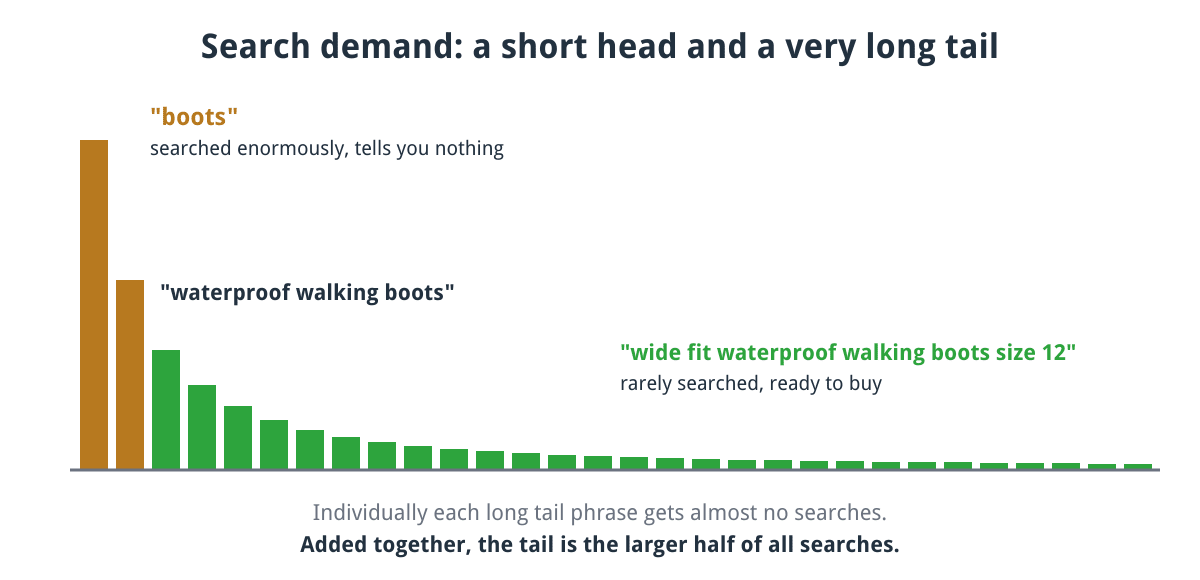
Where the name comes from: a few phrases with huge volume, then a very long tail of specific ones.
Click for full sized image
Compare “boots”, “waterproof walking boots” and “wide fit waterproof walking boots size 12”. The first is searched enormously and tells you nothing about the person. The last is searched rarely and tells you everything: they know their size, they have a fitting problem, and they are ready to buy.
The name comes from the shape of the demand curve. A few phrases get enormous volume, and then there is a very long tail of phrases that individually get almost none. Added together, that tail is the larger half of all searches, and a substantial share of them have never been searched before in exactly that form.
Why they are worth more than they look
You can actually rank for them. Competition falls away sharply as phrases get more specific. A well written page on a small site can rank for a four word phrase that a large competitor has never thought about.
They convert far better. Someone searching “boots” might be researching, comparing or window shopping. Someone searching for a specific product in a specific size is at the end of that process. The traffic is smaller and worth more per visit.
They add up. Two hundred phrases bringing three visits a month each is six hundred visits, from people who mostly know what they want. That is a better outcome than a handful of visits from a broad term you fought for.
They match how people now search. Voice queries and questions typed into AI assistants are conversational and long. “Where can I buy wide fit walking boots in the UK” is a long tail query whether it is typed or spoken.
Finding them without paying for tools
Google Search Console is the best source and most people ignore it. The Performance report lists the actual queries that brought people to your site. Sort by impressions and look for phrases where you appear but rank poorly, positions eight to twenty. Those are pages Google already considers relevant, which need a nudge rather than a rewrite. It is the highest return list you have access to.
Autocomplete. Start typing your product into Google and read the suggestions. Those are real searches. Add a letter at a time to fan out further.
People Also Ask and Related Searches. Both are lists of genuine phrasing, free, on every results page.
Your own site search. What visitors type into your search box is exactly what they expected you to sell, in their words. If they are searching for things you stock, your navigation is failing them. If they are searching for things you do not stock, that is a range decision.
Your support inbox. The questions customers ask before buying are long tail queries with the search box removed.
Using them properly
One page, one intent. A page should answer one question thoroughly. Cramming twelve variations into a single page ranks it for none of them.
Do not build doorway pages. Generating a near-identical page for every variant of a phrase is an old tactic that now attracts a penalty rather than traffic. If two phrases mean the same thing, they are one page.
Write for the person, not the parser. Search engines have handled synonyms and related concepts for years. Repeating an exact phrase awkwardly reads badly and gains nothing. Cover the subject properly and the variations take care of themselves.
Put the phrase where it counts: in the title tag, in the h1, in the first paragraph, and in the URL if you are creating a new page. Then stop thinking about it and write.
For shops specifically
Category pages carry the mid-length terms. “Waterproof walking boots” belongs to a category page, and those pages deserve real descriptive copy rather than a bare grid of products.
Product pages carry the specific ones. Model names, codes, sizes and colours. Manufacturer descriptions are the enemy here, because dozens of shops have the identical text. Rewriting them is dull and it is often the single highest return SEO work available to a shop.
Reviews generate long tail content for free. Customers describe products in language you would not have used, and that language matches what other customers search for.
Be careful with filters. Faceted navigation can generate thousands of near-identical URLs. Left unmanaged this buries the pages that matter under combinations nobody searches for. Decide which filtered views are worth indexing and use canonical tags or noindex for the rest.
A realistic expectation
This is slow. You are not going to publish a page and watch it arrive. You are building a lot of pages that each bring a small amount of qualified traffic, and the effect accumulates over months.
The compensation is that it is durable. Rankings built on genuinely useful, specific pages do not evaporate the way rankings built on tactics do.
Where to start
Open Search Console, go to the Performance report, set the date range to the last three months, and sort by impressions. Find the queries where you are in positions eight to twenty.
Pick five. Look at the page ranking for each and ask whether it genuinely answers that query. Usually it half does. Improve those five pages.
That is a morning’s work against a list of things Google has already told you it is willing to rank you for.
Our SEO and marketing service can help if you would rather hand it over. If you host with us and want a hand reading your Search Console data or working out which pages to improve first, get in touch.
